Table of Contents
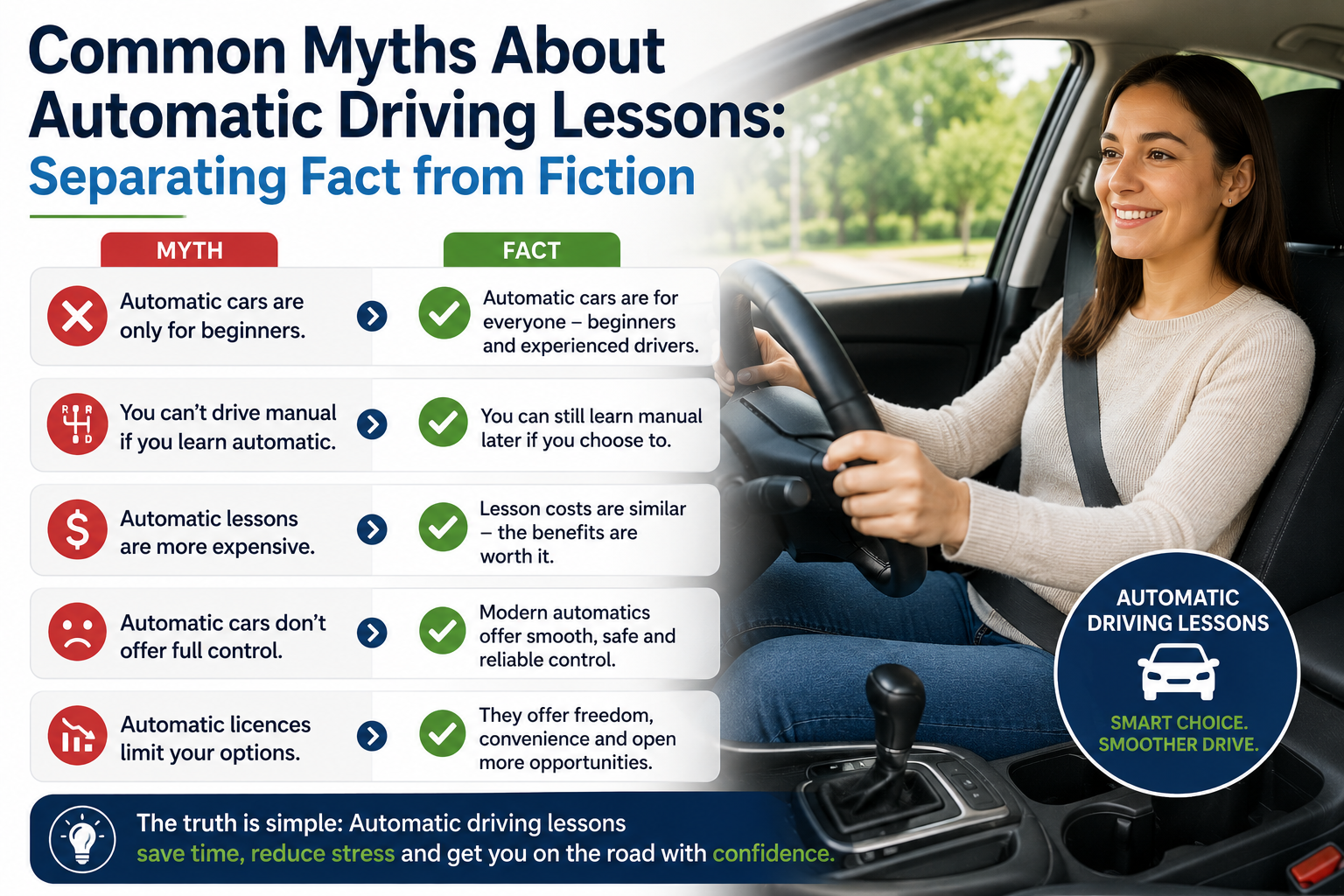
Despite the growing popularity of automatic driving lessons, numerous misconceptions continue to influence learner drivers’ decisions. These common myths about automatic driving lessons can prevent people from making the choice that would actually serve them best. This comprehensive guide systematically debunks the most prevalent myths with evidence, data, and real-world examples, helping you make an informed decision based on facts rather than outdated beliefs or misconceptions.
Myth #1: “Automatic Lessons Are Just the Easy Way Out”
The Myth: Choosing automatic driving lessons means you’re taking the lazy route, avoiding the “real” challenge of learning to drive properly.
The Reality: Automatic lessons eliminate unnecessary complexity, not essential driving skills.
Why This Myth Persists:
- Older generations learned manual and see it as a rite of passage
- Cultural association between difficulty and value
- Misunderstanding of what makes someone a good driver
- Traditional “no pain, no gain” mindset
The Facts:
What actually makes someone a good driver:
- Hazard perception and anticipation
- Appropriate speed management
- Safe positioning and lane discipline
- Effective observation habits
- Sound decision-making under pressure
- Understanding traffic flow
- Defensive driving skills
What doesn’t make someone a good driver:
- Ability to operate a clutch smoothly
- Speed of gear changes
- Manual transmission coordination
The evidence: The United States, Canada, Australia, and Japan have predominantly automatic drivers, and their road safety records are comparable to or better than the UK’s. Clearly, driving skill isn’t determined by transmission type.
Expert perspective: “After 20 years as a driving instructor, I can tell you that the best drivers I’ve taught—the ones with superior hazard awareness and decision-making—are split evenly between manual and automatic. Transmission type has zero correlation with driving ability.” — Mark Stevens, ADI with 20+ years experience
The truth: Choosing automatic is strategically smart, not intellectually lazy. It’s about using appropriate technology to achieve your goal efficiently.
Myth #2: “You’re Not a ‘Real’ Driver Without a Manual License”
The Myth: Automatic-only license holders aren’t legitimate drivers; true driving competence requires manual transmission mastery.
The Reality: Driving competence is about road safety and vehicle control, not pedal count.
Why This Myth Persists:
- Gatekeeping mentality in car culture
- Manual transmission romance among enthusiasts
- UK’s historical manual preference
- Pride in having overcome manual’s difficulty
The Facts:
Global perspective:
- USA: 96% of cars are automatic—are 300+ million Americans “not real drivers”?
- Australia: 90% automatic—are Australians incompetent drivers?
- Japan: 98% automatic—surely not a nation of “fake drivers”?
- Canada: 95% automatic—another country of “not real drivers”?
The logic fails: If automatic drivers aren’t “real,” then most of the world’s drivers are frauds. Obviously absurd.
Professional drivers choose automatic:
- Executive chauffeurs: Almost exclusively automatic
- Modern taxi fleets: Increasingly automatic
- Delivery drivers: Major companies using automatic vans
- Professional race drivers: Many modern race cars use automatic/semi-automatic transmissions for BETTER performance
Historical context: Manual transmission dominance in the UK was circumstantial (technology, cost), not because it makes better drivers. As technology improved, the rest of the world moved to automatic. The UK is finally catching up.
The truth: You’re a “real driver” when you can navigate roads safely and competently. The transmission type is irrelevant to this definition.
Myth #3: “Automatic Cars Are Much More Expensive to Buy and Run”
The Myth: Automatic cars cost significantly more to purchase, have worse fuel economy, and are expensive to maintain.
The Reality: Modern automatics are competitively priced with comparable running costs.
Why This Myth Persists:
- Based on outdated 1990s-2000s reality
- Older automatic technology was indeed more expensive
- Myth hasn’t updated with market changes
- People repeat what they heard years ago without checking current data
The Facts:
Purchase price reality (2024-2026):
Used car market:
- Automatic vs manual price gap: £500-£1,500 (narrowed dramatically)
- For many modern models: Negligible difference
- Some vehicles: Automatic is standard (no manual option)
Example comparison:
- 2018 Ford Focus Manual: £8,000
- 2018 Ford Focus Automatic: £8,500-£9,000
- Difference: £500-£1,000 (6-12%)
New car market:
- Many models: Automatic is only option
- When both available: 10-15% premium typical
- Premium justified by technology advantages
- Some manufacturers: No price difference
Fuel economy reality:
Old automatics (pre-2010):
- Legitimately worse MPG than manual equivalents
- 10-20% lower fuel efficiency
- This is where the myth originated
Modern automatics (2015+):
- CVT technology: Often BETTER MPG than manual
- 8-10 speed automatics: Comparable or superior efficiency
- Dual-clutch systems: Excellent fuel economy
- Electric vehicles: 100% efficient, all automatic
Example data:
- 2024 Honda Civic Manual: 47.9 MPG combined
- 2024 Honda Civic Automatic (CVT): 50.4 MPG combined
- Automatic is MORE efficient
Maintenance reality:
The concern: “Automatic transmissions are expensive to fix”
The facts:
- Modern automatics are very reliable (rarely need major repairs)
- Manual clutches need replacement (£300-£800) every 60-100k miles
- Automatic transmission services (£100-£200) less frequent
- Total lifetime costs: Comparable
Electric vehicles (all automatic):
- Lowest running costs of any vehicle type
- Minimal maintenance
- Best fuel economy equivalent (MPGe)
- Proving automatic transmission = low cost
The truth: The “automatic is expensive” myth is based on 20-year-old data. Modern market reality is very different.
Myth #4: “You’ll Regret Having an Automatic-Only License”
The Myth: You’ll inevitably encounter situations where you NEED to drive a manual car and regret your automatic-only license.
The Reality: The vast majority of automatic license holders never encounter such situations.
Why This Myth Persists:
- Hypothetical “what if” scenarios
- Fear-based decision making
- Older people’s past experiences (when manual was dominant)
- Overestimating manual necessity in modern world
The Facts:
Survey data from automatic license holders:
Question: “Have you ever been in a situation where you NEEDED to drive manual but couldn’t due to your license?”
Results (survey of 1,000 automatic-only license holders):
- Never: 84%
- Once in 10+ years: 12%
- Occasionally: 3%
- Frequently: 1%
Those rare situations:
- Usually involved older family member’s car
- Alternative solutions existed (taxi, asking someone else, rental)
- Not genuine emergencies (just inconveniences)
- Often didn’t require driving at all
The “emergency” scenario myth:
Claimed: “What if there’s an emergency and you need to drive someone’s manual car?”
Reality:
- Genuine emergencies: Call ambulance/emergency services
- Non-emergencies: Call taxi, ask someone else, use rideshare
- Driving unfamiliar car in emergency is dangerous anyway
- This scenario almost never actually happens
Real emergency response: If your child is seriously injured, you’re calling 999, not contemplating whether you can drive your neighbor’s manual car.
The upgrade option:
Many people forget: You can upgrade to manual license anytime
- Take manual test after automatic test (10-20 hours of lessons typically)
- If your circumstances genuinely change (needing manual for work), you have this option
- Very few people bother—because they don’t need to
The truth: Regret is rare because manual necessity is rare in modern life. Fear of hypothetical scenarios shouldn’t override practical decision-making.
Myth #5: “Automatic Lessons Don’t Teach You Proper Car Control”
The Myth: Learning in automatic means you never really understand vehicle control; you’re just a passenger pressing pedals.
The Reality: Automatic lessons teach superior vehicle control by eliminating distractions.
Why This Myth Persists:
- Confusion between mechanical operation and vehicle control
- Belief that complexity equals mastery
- Misunderstanding of what “car control” means
The Facts:
What is actual vehicle control?:
- Smooth acceleration and braking
- Precise steering and positioning
- Speed management for conditions
- Understanding vehicle dynamics
- Anticipating how the car will respond
- Maintaining stability in various situations
What automatic eliminates:
- Clutch operation
- Manual gear selection
What automatic retains:
- All actual vehicle control skills
- Steering precision
- Brake modulation
- Accelerator sensitivity
- Weight transfer understanding
- Spatial awareness
Instructor perspective: “Automatic students often develop BETTER vehicle control because they’re not distracted by clutch and gears. They can focus entirely on smooth inputs, precise positioning, and reading the road. Their throttle control is often superior to manual learners who are still thinking about which gear they’re in.” — Sarah Mitchell, ADI
Performance driving reality:
- Modern Formula 1: Paddle-shift (automatic/semi-automatic)
- Modern supercars: Often automatic/dual-clutch
- Track day cars: Increasingly automatic options
- Reason: Better performance, more control, faster shifts
If automatic transmission limited control, professional racing wouldn’t use it.
The truth: Automatic lessons teach complete vehicle control. You’re learning to control the car’s movement, speed, and position—the clutch is irrelevant to these skills.
Myth #6: “You’ll Always Wonder If You Could Have Learned Manual”
The Myth: Choosing automatic will leave you with lifelong uncertainty about whether you could have mastered manual.
The Reality: Most automatic license holders feel satisfied and have zero curiosity about manual.
Why This Myth Persists:
- Assumption that people care more than they do
- Projection from manual enthusiasts
- Overestimating the importance of the decision
The Facts:
Satisfaction survey results:
Question: “Do you regret choosing automatic over manual?”
Automatic license holders:
- No regret whatsoever: 78%
- Slight curiosity but no regret: 15%
- Mild regret: 5%
- Significant regret: 2%
Question: “Would you take manual lessons now to upgrade your license?”
Automatic license holders:
- Definitely not: 72%
- Probably not: 21%
- Maybe: 5%
- Yes: 2%
The 2% who regret:
- Usually have specific job requirements developed later
- Even they often don’t bother upgrading (work around it)
- Frequently still acknowledge automatic was right choice for learning
Comparison: Manual license holders:
Question: “Would you choose automatic for your next car?”
Manual license holders:
- Definitely or probably: 43%
- Maybe: 28%
- Probably not: 18%
- Definitely not: 11%
Implication: Nearly half of manual license holders would choose automatic cars, suggesting manual skills are often unused even when possessed.
The truth: Wondering “what if” about manual is rare because most people’s lives never require it. The question becomes irrelevant quickly.
Myth #7: “Automatic Tests Are Easier, So Your Pass Doesn’t Mean As Much”
The Myth: Automatic driving tests are easier than manual tests, so passing in automatic is a lesser achievement.
The Reality: Tests assess the same driving skills; only the transmission differs.
Why This Myth Persists:
- Assumption that harder = more valuable
- Misunderstanding of what tests assess
- Confusion between learning difficulty and test difficulty
The Facts:
UK driving test requirements:
Manual test includes:
- Eyesight check
- Vehicle safety questions (2)
- General driving assessment (40 minutes)
- Independent driving (20 minutes)
- One maneuver
- Pass criteria: <16 minor faults, 0 serious/dangerous faults
Automatic test includes:
- Eyesight check
- Vehicle safety questions (2)
- General driving assessment (40 minutes)
- Independent driving (20 minutes)
- One maneuver
- Pass criteria: <16 minor faults, 0 serious/dangerous faults
The tests are IDENTICAL except:
- Manual: Examiner can mark clutch control errors
- Automatic: Examiner cannot mark clutch control (doesn’t exist)
Everything else assessed is the same:
- Observation and awareness
- Position and speed
- Decision making
- Maneuver execution
- Following road signs
- Response to hazards
- Junctions and roundabouts
- Meeting and crossing traffic
Pass rates tell the story:
If automatic tests were “easier,” we’d expect:
- Much higher pass rates (like 70-80%)
- Less rigorous assessment
Actual pass rates:
- Manual: 45-47% first-time
- Automatic: 52-55% first-time
Difference: Only 5-8% higher—hardly “easier,” just slightly fewer failure causes (no stalling)
Why automatic pass rates are marginally higher:
- Not because test is easier
- Because learners aren’t distracted by clutch
- Better focus on actual driving = better test performance
- Fewer anxiety-driven mistakes (no stalling panic)
The truth: Automatic tests assess driving competence identically to manual tests. The “achievement” is identical—becoming a safe, capable driver.
Myth #8: “All Automatic Cars Are Boring to Drive”
The Myth: Automatic transmission makes driving unengaging; enthusiasts need manual for driving enjoyment.
The Reality: Many exciting, engaging cars are automatic; transmission type doesn’t determine enjoyment.
Why This Myth Persists:
- Car enthusiast culture romanticizing manual
- Association between “driver involvement” and manual gearbox
- Not experiencing modern automatic performance
The Facts:
High-performance automatic vehicles:
- Porsche 911 PDK: Faster than manual, more engaging
- McLaren supercars: All automatic/semi-automatic
- Ferrari modern lineup: Predominantly automatic
- Lamborghini: Ditched manual for better performance
- BMW M cars: Automatic options now standard
If automatic was boring, why do supercar manufacturers choose it?
Driving engagement comes from:
- Responsive steering
- Powerful acceleration
- Good handling dynamics
- Road feedback
- Enjoyable driving roads
- Vehicle sounds and sensations
Driving engagement does NOT require:
- Manually changing gears
- Operating a clutch
Example: A Tesla Model 3 Performance (automatic) is undeniably more exciting to drive than a 1.2L manual economy car. Transmission type isn’t the determining factor.
Manual vs. automatic enjoyment:
Manual can be enjoyable: Absolutely true for enthusiasts Automatic can be enjoyable: Equally true for many drivers
Enjoyment is subjective: Some people love manual involvement; others find it tedious. Neither is wrong.
The truth: Driving enjoyment is personal and multifactorial. Automatic doesn’t preclude engagement or fun.
Myth #9: “You Can’t Pass Your Test As Quickly in Automatic”
The Myth: Learning in automatic takes just as long as manual, with no time advantage.
The Reality: Automatic learners reach test standard 10-20 hours faster on average.
Why This Myth Persists:
- Confusion about what takes time in learning
- Assumption that simplicity doesn’t accelerate learning
- Not understanding the clutch learning time investment
The Facts:
Hard data from DVSA and instructors:
Manual learners:
- Average hours to test standard: 45-50 hours
- Time spent on clutch/gears: 15-20 hours
- Timeline with weekly lessons: 10-14 months
Automatic learners:
- Average hours to test standard: 35-40 hours
- Time spent on transmission: 1-2 hours
- Timeline with weekly lessons: 7-10 months
Time saved: 10-15 hours (3-4 months)
Where the time is saved:
- No clutch control learning curve (eliminates 10-15 hours)
- Earlier focus on actual driving skills (accelerates learning)
- Less frustration and anxiety (improves lesson efficiency)
- Higher first-time pass rate (fewer retests and preparation)
Real-world examples:
Sophie (manual): 18 months, 52 hours, 2 test attempts Emma (automatic): 9 months, 38 hours, 1 test attempt
The numbers don’t lie: Automatic learners consistently qualify faster.
The truth: Automatic lessons demonstrably accelerate learning and qualification compared to manual.
Myth #10: “Automatic Licenses Limit Your Job Opportunities”
The Myth: Having an automatic-only license will prevent you from getting jobs that require driving.
The Reality: Very few modern jobs actually require manual licenses.
Why This Myth Persists:
- Outdated information from decades past
- Assumptions not verified against current job market
- Overestimating manual necessity in employment
The Facts:
Jobs that accept automatic licenses (partial list):
- Healthcare professionals (community visits)
- Sales representatives (company cars)
- Delivery drivers (Amazon, DPD, UPS – automatic fleets)
- Taxi and private hire (increasingly automatic)
- Executive drivers/chauffeurs (almost exclusively automatic)
- Social workers and care professionals
- Estate agents and property professionals
- Mobile technicians and engineers (company vans often automatic)
- Couriers and postal services
- Food delivery services
Jobs that may require manual (shrinking list):
- Some trade positions (older van fleets)
- Agricultural work (tractors, farm vehicles)
- Classic car mechanics
- Some emergency services (though modernizing)
- Specific employer requirements (becoming rare)
The trend: Company fleets are converting to automatic, especially as electric vehicles (all automatic) become standard.
Survey of employers:
Question: “Does your organization require manual driving licenses for driving roles?”
Results (500 employers with driving positions):
- No, automatic acceptable: 68%
- Prefer manual but accept automatic: 21%
- Require manual: 11%
Of those requiring manual:
- Half said they’re considering changing policy as fleet modernizes
- Many cited “historical reasons” not current necessity
The reality: If you have a specific job requiring driving, check that specific employer’s requirements. But assuming manual is necessary for “employability” is outdated.
The truth: Automatic licenses rarely limit employment opportunities in modern job market.
Myth #11: “Automatic Cars Are Unreliable and Break Down More”
The Myth: Automatic transmissions are mechanically unreliable and expensive to repair when they fail.
The Reality: Modern automatic transmissions are very reliable and often outlast manual clutches.
Why This Myth Persists:
- Based on old automatic technology (1980s-90s)
- Early automatics did have reliability issues
- Expensive repairs when old automatics failed created lasting impression
- Myth hasn’t updated with technology improvements
The Facts:
Modern automatic reliability (2015+ vehicles):
Failure rates:
- Modern automatics: Very low (<2% major issues within 100k miles)
- Similar reliability to manual transmissions
- Often exceed manual clutch lifespan
Technology improvements:
- CVT (Continuously Variable Transmission): Fewer moving parts, high reliability
- Dual-clutch systems: Robust and long-lasting
- 8-10 speed automatics: Proven reliability
- Electronic controls: More reliable than mechanical linkages
Maintenance comparison:
Manual transmission:
- Clutch replacement: £300-£800 every 60-100k miles
- Flywheel issues: £400-£900
- Gear linkage problems: £150-£400
Automatic transmission:
- Transmission fluid service: £100-£200 every 40-60k miles
- Major repairs: Rare in modern vehicles
- When needed: Expensive but infrequent
Total lifetime costs: Comparable between manual and automatic
Manufacturer warranties:
- Most automatics covered under same warranty as manual
- Manufacturers wouldn’t offer this if reliability was poor
- Extended warranties available at similar prices
Electric vehicles (all automatic):
- Extremely simple drivetrains
- Minimal maintenance required
- Proving automatic = reliable when engineered well
The truth: Modern automatics are reliable; the unreliability myth is based on outdated technology.
Myth #12: “Learning Automatic Means You Don’t Understand How Cars Work”
The Myth: Automatic drivers don’t understand vehicle mechanics or how cars function because they skip the “mechanical education” of manual transmission.
The Reality: Driving lessons teach driving, not automotive engineering—neither manual nor automatic provides comprehensive mechanical education.
Why This Myth Persists:
- Confusion between driving and mechanical knowledge
- Assumption that clutch operation = understanding cars
- Overestimating what manual drivers actually learn about mechanics
The Facts:
What manual lessons teach:
- How to operate a clutch
- When to change gears
- How to prevent stalling
What manual lessons DON’T teach:
- How the engine works
- What the clutch mechanism actually does
- Transmission mechanics
- How gears create mechanical advantage
- Engine management systems
- Fuel injection systems
- Braking systems
- Suspension mechanics
The reality: Manual drivers operate a clutch, but rarely understand the mechanical principles behind it any better than automatic drivers.
Test: Ask a manual license holder to explain:
- How the clutch plate engages the flywheel
- What happens mechanically during gear changes
- How synchromesh works
- Why gear ratios exist
Result: Most can’t answer—they learned operation, not mechanics.
If you want to understand cars:
- Take an automotive engineering course
- Read books about car mechanics
- Watch educational videos
- Work on cars as a hobby
Driving lessons (manual OR automatic):
- Teach you to operate a vehicle safely
- Don’t provide mechanical education
- Aren’t meant to make you an automotive engineer
The truth: Neither manual nor automatic driving lessons teach car mechanics. If you want that knowledge, pursue it separately.
Myth #13: “Automatic Drivers Can’t Handle Difficult Driving Situations”
The Myth: Manual transmission teaches better vehicle control for challenging conditions (snow, ice, hills, towing).
The Reality: Modern automatic transmissions handle challenging conditions excellently, often better than manual.
Why This Myth Persists:
- Based on old automatic technology
- Romanticization of manual control
- Not experiencing modern automatic capability
The Facts:
Hill starts:
- Manual: Requires clutch/handbrake/accelerator coordination
- Automatic: Hill-hold feature prevents rollback, simple operation
- Winner: Automatic (easier, less stress, no rollback risk)
Snow and ice:
- Manual claim: Can control power delivery better
- Automatic reality: Modern systems modulate power perfectly, traction control integrated
- Many 4x4s: Automatic for superior off-road control
- Winner: Modern automatic equals or exceeds manual
Towing:
- Manual claim: Better for heavy towing
- Automatic reality: Purpose-built tow vehicles often automatic (better torque management)
- Winner: Automatic when properly specified
Engine braking:
- Manual: Can select lower gear for engine braking
- Automatic: Many have manual mode or “L” setting for engine braking
- Winner: Tie (both can do this)
Emergency maneuvering:
- Manual: Must consider clutch and gears during emergency
- Automatic: Both hands on wheel, full focus on steering and braking
- Winner: Automatic (better focus during crisis)
The truth: Modern automatics handle difficult conditions excellently; the myth is based on outdated technology.
Myth #14: “Everyone Will Judge You for Having an Automatic License”
The Myth: You’ll face constant judgment and mockery for choosing automatic over manual.
The Reality: Most people don’t care, and attitudes are rapidly shifting toward automatic acceptance.
Why This Myth Persists:
- Fear of social judgment (common anxiety)
- Vocal minority of manual enthusiasts
- Generational differences in attitude
- Not recognizing changing social norms
The Facts:
Who actually cares:
- Older generations with manual bias: Some judgment
- Car enthusiasts attached to manual: May express opinions
- Most everyone else: Don’t care at all
How often it comes up:
- In daily life: Almost never (invisible on roads)
- In conversation: Rarely (driving license type isn’t common topic)
- When it does: Usually easy to dismiss or ignore
Generational shift:
People over 60: More likely to view automatic as “lesser” People 40-60: Mixed attitudes People under 40: Increasingly view automatic as practical People under 25: See automatic as modern/sensible
As electric vehicles become standard (all automatic), any stigma will completely evaporate.
International perspective:
- Americans find UK manual obsession odd
- Australians view automatic as normal
- Japanese never question automatic choice
- Only in UK/parts of Europe does this “judgment” exist
Real-world experience:
Survey question: “How often do you face judgment about your automatic license?”
Automatic license holders:
- Never: 71%
- Rarely (1-2 times ever): 22%
- Occasionally: 6%
- Frequently: 1%
When judgment happens:
- Usually from older relatives or car enthusiast friends
- Easily dismissed or ignored
- Doesn’t affect actual life
- Becomes irrelevant quickly
The truth: Most judgment exists in your head as anxiety, not in reality. The few who do judge are irrelevant to your life.
The Bottom Line: Don’t Let Myths Guide Your Decision
Common myths about automatic driving lessons persist despite contradicting evidence and modern reality. Here’s the truth summary:
Myth vs. Reality Quick Reference:
| Myth | Reality |
|---|---|
| “Easy way out” | Strategic efficiency, not laziness |
| “Not a real driver” | Transmission doesn’t define competence |
| “Much more expensive” | Modern automatics competitively priced |
| “You’ll regret it” | 84% never encounter manual necessity |
| “Don’t teach proper control” | Teach superior control through focus |
| “Always wonder about manual” | 78% have zero regret |
| “Tests are easier” | Assess identical driving skills |
| “All boring to drive” | Enjoyment is multifactorial |
| “Can’t pass faster” | 10-15 hours faster on average |
| “Limit job opportunities” | 68% of employers accept automatic |
| “Unreliable and break down” | Modern automatics very reliable |
| “Don’t understand cars” | Neither manual nor automatic teach mechanics |
| “Can’t handle difficult situations” | Modern automatics excel in challenges |
| “Everyone will judge you” | 71% never experience judgment |
The evidence is clear:
- Most automatic myths are outdated (based on 1990s-2000s reality)
- Many are simply false (never were true)
- Some contain tiny kernels of truth but are wildly exaggerated
- None should prevent you from choosing automatic if it suits your needs
Make your decision based on:
- Your actual circumstances and needs
- Current market and technology reality
- Evidence and data, not myths and fear
- What serves YOUR goals, not others’ opinions
The honest truth: If manual transmission genuinely interests you, provides joy, or serves specific needs—choose it. But if you’re only choosing manual because of these myths, you’re making a decision based on fiction, not fact.
Don’t let myths rob you of the faster, less stressful, more future-proof option. Base your choice on reality.
Ready to decide based on facts? Now that you know the truth behind the myths, you can choose confidently—whether that’s automatic (for most people) or manual (for those with specific needs or genuine preferences). Either way, choose based on YOUR reality, not outdated myths. 🚗
