Table of Contents
Choosing between an automatic and manual driving test is an important decision that can affect how you learn, how quickly you progress, and what type of licence you receive. While the structure of both tests is largely the same in the UK, there are key differences that every learner should understand before booking their practical exam.
1. Test Structure: Mostly the Same
Both automatic and manual driving tests follow the same format set by the DVSA. Each test includes:
- Eyesight check
- “Show me, tell me” vehicle safety questions
- General driving ability assessment
- One manoeuvre (e.g., parallel park, bay park, pull up on the right)
- Approximately 20 minutes of independent driving
The marking system is identical. You can receive:
- Up to 15 minor faults (driving faults)
- No serious or dangerous faults
This means the examiner assesses the same standards of safety, awareness, positioning, and decision-making regardless of transmission type.
2. The Main Difference: Gear Control
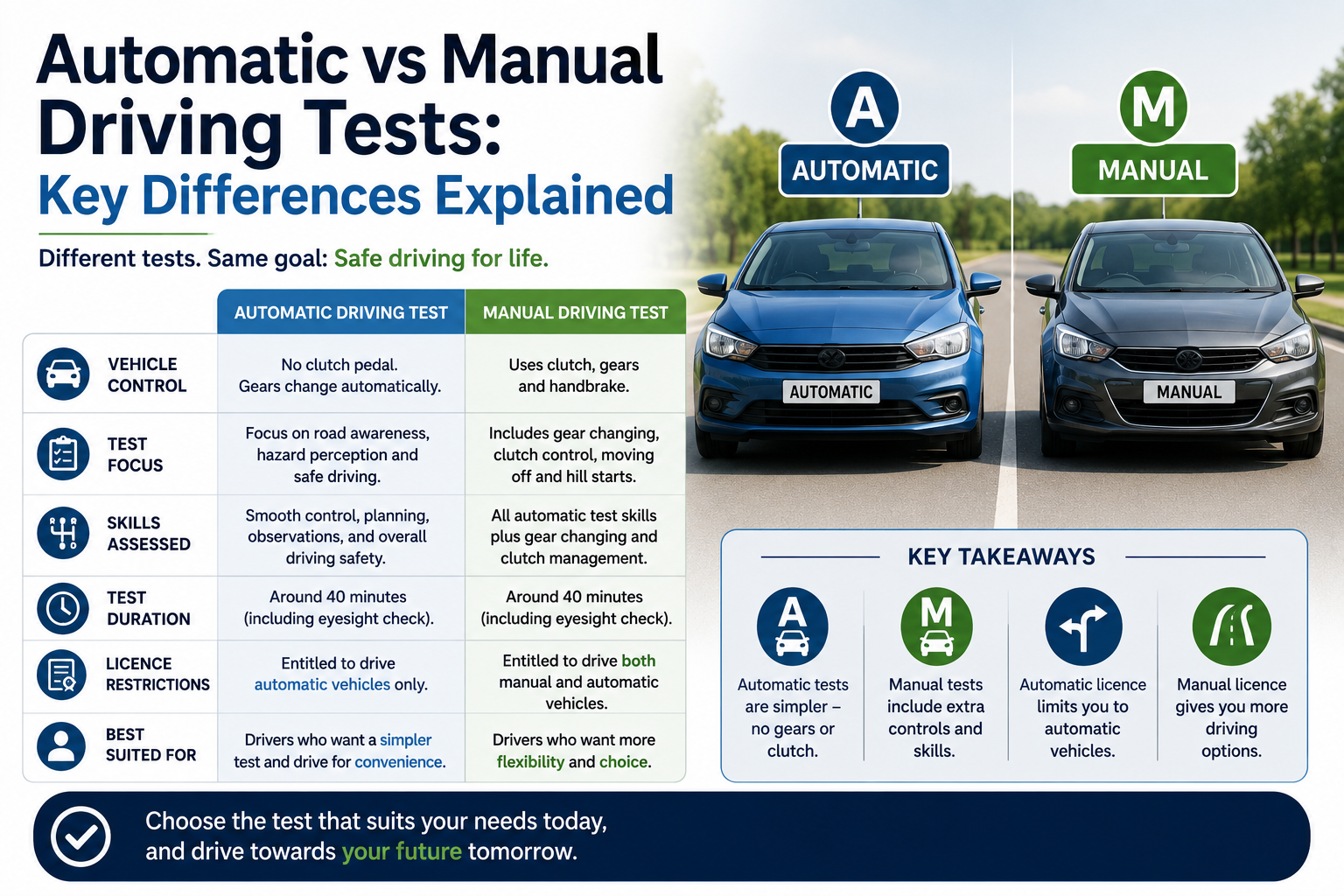
The biggest distinction is clutch control and gear changes.
Manual Test
In a manual car, you must demonstrate:
- Smooth clutch control
- Correct gear selection
- Hill starts without rolling
- No stalling in unsafe situations
Poor clutch control can result in minor or serious faults, especially if it affects other road users.
Automatic Test
In an automatic car:
- There is no clutch pedal
- No manual gear changes
- No risk of stalling due to clutch control
This reduces the mechanical complexity of the test. Learners can focus entirely on road awareness, positioning, speed control, and observation.
3. Difficulty Level
Many learners find automatic tests feel easier because:
- There are fewer tasks to manage at once
- Less coordination is required
- There is reduced pressure at junctions and roundabouts
- Hill starts are simpler
In manual cars, learners must multitask under pressure, especially in heavy traffic. Automatic vehicles remove that layer of complexity.
However, it’s important to note:
The driving standard required to pass is exactly the same. You must still demonstrate safe, confident driving.
4. Licence Restrictions
This is the most significant long-term difference.
- Pass in a manual car → You can drive both manual and automatic vehicles.
- Pass in an automatic car → You can only legally drive automatic vehicles.
If you later want to drive a manual car after passing in an automatic, you must take another practical test in a manual vehicle.
That said, with the rise of hybrid and electric cars (which are automatic), many learners now see automatic licences as practical and future-focused.
5. Learning Time & Pass Rates
Some learners progress faster in automatic lessons because they spend less time mastering clutch control and gear coordination. This can mean:
- Faster confidence building
- More time spent on test routes and manoeuvres
- Potentially fewer overall lessons
However, pass rates vary depending on the learner, instructor quality, and preparation — not just transmission type.
6. Cost Considerations
Manual lessons can sometimes require more hours for beginners who struggle with clutch control. Automatic lessons may allow some learners to reach test standard sooner.
However, automatic cars can sometimes be slightly more expensive per lesson depending on location and instructor availability.
7. Who Should Choose Automatic?
Automatic may be ideal for:
- Nervous drivers
- Learners who struggled in manual
- Those wanting a quicker, simpler learning process
- Drivers planning to use electric or hybrid vehicles
Manual may suit:
- Learners who want maximum licence flexibility
- Drivers who may need to use manual vehicles for work
- Those comfortable with mechanical coordination
Final Thoughts
The automatic and manual driving tests are assessed to the same safety standards, but the experience of taking them differs significantly. Manual tests require additional mechanical skill in clutch control and gear selection, while automatic tests allow learners to focus purely on road awareness and safe driving behaviour.
The right choice depends on your confidence level, future driving needs, and personal learning style. Whichever option you choose, proper preparation, structured lessons, and mock driving tests will give you the best chance of passing first time.
