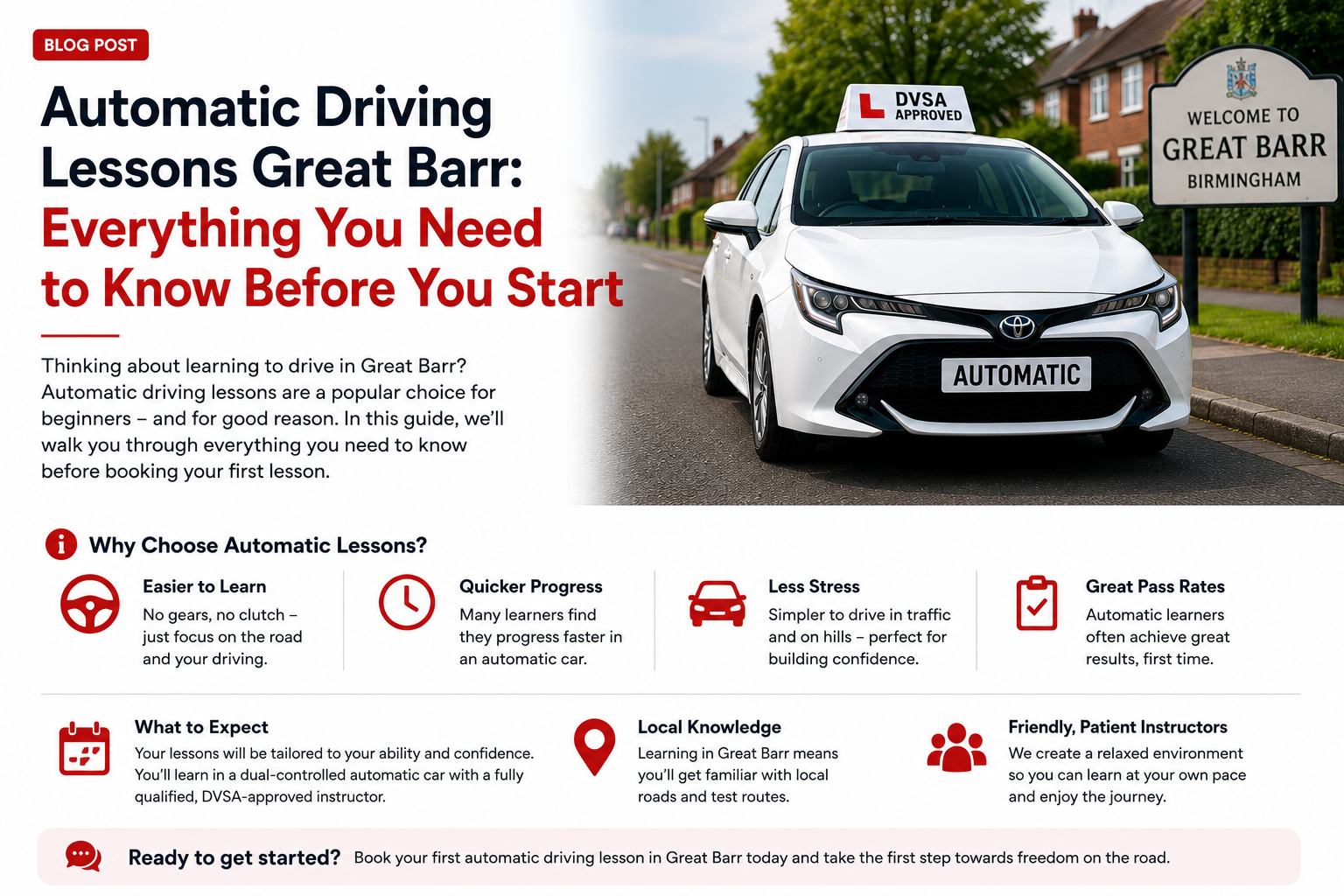
Looking for automatic driving lessons in Birmingham? Our automatic driving lessons are designed to help beginners and nervous drivers learn with confidence. With DVSA-approved instructors, modern automatic cars, and flexible lesson times, you’ll gain the skills you need to pass your driving test and drive safely for life.
Our Automatic Driving Lessons Courses are designed to help learners of all experience levels become safe, confident drivers. Whether you’re a complete beginner, preparing for your practical test, or looking for refresher lessons, our DVSA-approved instructors provide professional, one-to-one tuition in modern automatic vehicles. With flexible lesson times, affordable prices, and a high pass rate, our automatic driving lessons make learning to drive simple, stress-free, and effective.
Whether you’re a first-time learner or switching from manual, this guide covers everything about learning to drive automatically in Great Barr — from what the local roads are like to how much it costs and what to look for in an instructor.
Great Barr sits on the northern edge of Birmingham, straddling the boundary between the city’s busy urban core and the calmer residential streets of the West Midlands. For learner drivers, that position is genuinely advantageous — it offers an unusually varied training environment that covers everything from quiet suburban roads to challenging dual carriageways and complex junctions, all within a relatively compact area.
Learning to drive here means you’re exposed to the full range of conditions you’ll encounter as an independent driver. You won’t just be practising on easy roads — you’ll be building real confidence on the kinds of routes that prepare you thoroughly for both your test and a lifetime of safe driving.
Queslett RoadScott RoadAldridge RoadGreat Barr retail park routesA34 dual carriagewayResidential backstreetsLocal roundaboutsSchool zone areas
Good instructors in the area will typically begin lessons on the quieter residential streets before progressively introducing busier roads as confidence builds. By the time you’re approaching test standard, you’ll be comfortable handling the kind of mixed traffic conditions that characterise driving in and around Birmingham every day.
“Great Barr’s mix of quiet streets and busy arterial roads makes it one of the most well-rounded training environments in the Birmingham area.”
For learners in Great Barr and the surrounding Birmingham area, automatic lessons offer a particularly compelling set of advantages. The local road network — a blend of residential streets, busy A-roads, and frequent junctions — demands constant attention from a driver. In a manual car, that attention is split between the road and the mechanics of the gearbox. In an automatic, it can go entirely where it belongs: on the driving.
Stop-start urban traffic is where manual learners struggle most. Approaching a busy junction on Aldridge Road or navigating the roundabouts near Great Barr retail park requires smooth, confident vehicle control — and the anxiety of potential stalling makes that confidence much harder to develop. Automatic cars remove the problem entirely. There’s no clutch to manage, no biting point to find, and no risk of stalling in front of a queue of waiting traffic.
Without gear changes to think about, your brain is free to focus on what actually matters: reading the road ahead, checking mirrors, judging speed and distance, and making good decisions at junctions. These are the skills the examiner assesses — and they develop faster in learners who aren’t simultaneously managing a clutch pedal.
Many people who come to automatic lessons in Great Barr have tried manual and found it overwhelming. Some have avoided learning to drive for years because the complexity felt unmanageable. Automatic lessons consistently change that experience — not by making driving easier, but by removing an unnecessary layer of difficulty that was getting in the way of real progress.
Avg. hours to test: manual
45–55 hrs
Avg. hours to test: automatic
30–40 hrs
Typical time saving
10–15 hrs
Prices in Great Barr reflect the broader Birmingham market — slightly higher than the UK average due to urban running costs and demand for automatic instructors, but very much in line with what you’d expect for the area.
| Lesson type | Approx. cost |
|---|---|
| 1-hour automatic lessonStandard session, most flexible format | £35–£45per hour |
| 2-hour automatic lessonMore driving time, better value per hour | £70–£85recommended format |
| 10-hour block package Best valuePrepaid block, lowest effective hourly rate | ~£360–£400~£36–£40 per hour |
Automatic lessons typically cost £3–£5 more per hour than manual equivalents — a reflection of higher vehicle costs and greater demand relative to supply. However, because automatic learners generally reach test standard in fewer hours, the total spend across the full learning journey is often lower than a manual route would have been.
“Paying slightly more per hour for automatic lessons is almost always offset by needing fewer of them — making the total cost of learning to drive lower, not higher.”
There’s no fixed answer — every learner is different. But the DVSA’s national average of 45 hours for a manual learner drops considerably for automatic learners, who typically reach test standard in 30–40 hours of professional tuition. For nervous learners or those with prior driving experience, that figure can be lower still.

Several things influence how many hours you’ll need before you’re genuinely test-ready. Age plays a role — younger learners often build mechanical confidence faster, but older learners frequently bring better judgement and patience to the process. Frequency of lessons matters enormously: learners who take two or more lessons per week consistently reach test standard faster than those who lesson sporadically. Prior driving experience — even in a car park or on private land — also reduces the total hours needed.
The quality of your instructor is arguably the single most important variable. An experienced ADI who knows the local test routes, understands how you learn, and paces your progression appropriately will get you to test standard more efficiently than one who doesn’t — regardless of how many hours you put in.
The learners who progress fastest in Great Barr — and everywhere else — are the ones who lesson regularly and practice in between. Two lessons a week, combined with some accompanied practice in a private vehicle, is the combination that most reliably produces quick, confident progress. Long gaps between lessons allow skills to fade and force instructors to cover the same ground repeatedly, which wastes both time and money.
Once a week
~10–12 months
Twice a week
~5–6 months
Three times a week
~3–4 months
Choosing the right instructor is one of the most important decisions you’ll make as a learner driver — and it’s worth taking seriously. Not all ADIs are the same, and the difference between a great instructor and a mediocre one can mean dozens of extra hours and potentially multiple test failures.
Any instructor charging for driving lessons in the UK must be a DVSA-approved driving instructor (ADI) or a licensed trainee instructor (PDI). Always check that your instructor is on the ADI register before booking. You can verify this on the GOV.UK website using their licence plate number or name.
Not all ADIs have extensive experience teaching in automatics. Some primarily teach manual and only offer automatic lessons as a secondary option. For automatic learners — particularly nervous ones — an instructor who specialises in automatic tuition, or who has a strong track record with automatic students specifically, will typically deliver better outcomes.
Great Barr learners typically test at the Kingstanding or Great Barr test centres. An instructor who knows these routes intimately — who can prepare you specifically for the junctions, roundabouts, and road types that appear on local tests — is significantly more valuable than one who doesn’t. Ask directly about their local knowledge and pass rates at your nearest test centre.
For nervous learners especially, the instructor’s manner matters as much as their qualifications. A calm, patient, encouraging approach creates the conditions in which anxious learners can actually relax and absorb what they’re being taught. A single taster lesson is the best way to assess this — trust your instincts about whether the relationship feels right before committing to a block booking.
DVSA ADI registeredAutomatic specialistKnows local test routesStrong pass ratePatient with nervous learnersPositive reviews
If you’ve never driven before — or if you’ve only ever driven manual — your first automatic lesson will probably feel surprisingly manageable. The absence of a clutch pedal is immediately noticeable, and most first-time automatic learners comment that the car feels far easier to control than they expected.
Your instructor will likely begin with a cockpit drill — familiarising you with the controls, mirrors, and seating position before you touch the accelerator. From there, early lessons in Great Barr typically start on the quieter residential streets around the area: low-speed, low-traffic environments where you can build the basics of steering, braking, and observation without the pressure of busy roads.
In a manual car, the first few lessons are almost entirely focused on clutch control. In an automatic, that phase is eliminated — which means by the end of your first or second lesson, you’re often already moving through the gears on real roads, building genuine driving experience rather than practising car park starts.
Once basic control is established, your instructor will progressively introduce more complex environments: busier roads, junctions, roundabouts, and eventually dual carriageways and town centre driving. Each new challenge is introduced when you’re ready for it, not before — and a good instructor will make that judgement based on your actual progress, not a fixed schedule.
“Most automatic learners are genuinely surprised by how quickly they’re driving on real roads. The early progress feels fast — because it is.”
Passing your driving test in an automatic vehicle means you’ll hold an automatic-only licence. This is worth understanding before you start, so you can make an informed decision about whether automatic is the right choice for your long-term needs.
An automatic licence entitles you to drive any automatic or semi-automatic vehicle on UK roads — which, given the rapid growth of electric vehicles (all of which are automatic), covers an increasingly large proportion of the cars on the road today. If you later want to drive a manual car, you would need to pass an additional manual test.
For the vast majority of automatic licence holders, the answer is no. Most people who pass in automatic cars go on to buy or lease automatic vehicles — partly because automatics are more comfortable and easier to drive, and partly because the market is increasingly dominated by automatics and electrics anyway. The idea that a manual licence is essential for flexibility is becoming less relevant with every passing year.
If you’re confident you’ll only ever need to drive automatics — and the growth of electric vehicles makes that increasingly likely for most drivers — the automatic-only licence is no restriction at all. It’s simply the licence appropriate for the car you’ll actually be driving.
Automatic driving lessons in Great Barr offer learners in the area an efficient, lower-stress path to their driving licence. The local roads provide a genuinely varied training environment, automatic cars remove the single biggest source of learner anxiety, and the right instructor can get most learners to test standard in 30–40 hours.
Prices typically range from £35–£45 per hour for individual sessions, with two-hour lessons and block packages offering better value for committed learners. The slightly higher hourly rate compared to manual is almost always offset by needing fewer total hours — making the overall cost of an automatic licence lower, not higher, for most learners.
Whether you’re starting from scratch, switching from a failed manual experience, or returning to driving after a long gap, automatic lessons in Great Barr are worth serious consideration. The roads are well-suited to the format, the learning curve is gentler, and the outcome — a confident, independent driver — is exactly the same as with any other route to a licence.
Great Barr & surrounding area30–40 hrs to test standard£35–£45 per hourNo clutch or gear stressIdeal for nervous learnersFuture-proof for electric vehicles
