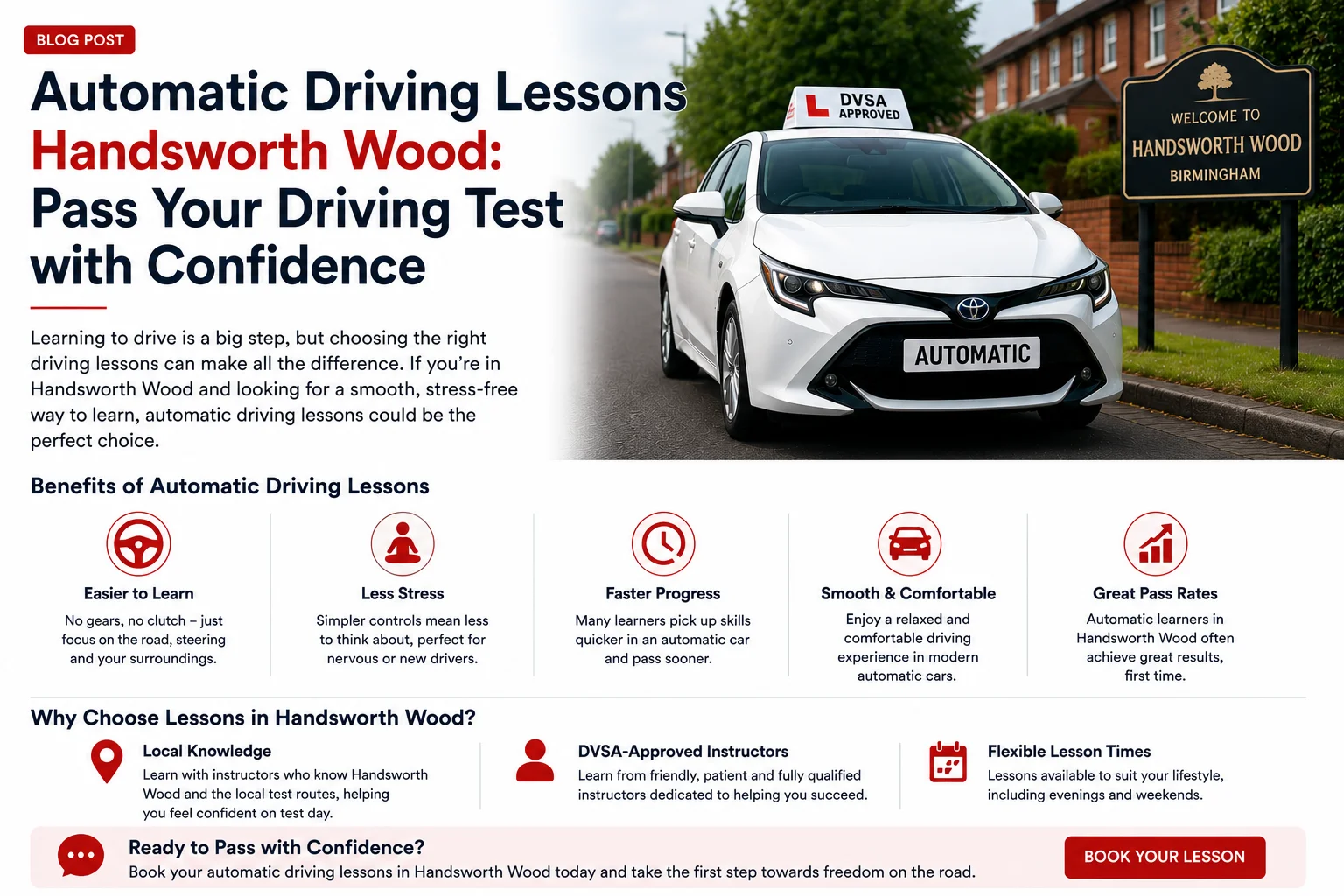
Looking for automatic driving lessons in Birmingham? Our automatic driving lessons are designed to help beginners and nervous drivers learn with confidence. With DVSA-approved instructors, modern automatic cars, and flexible lesson times, you’ll gain the skills you need to pass your driving test and drive safely for life.
Our Automatic Driving Lessons Courses are designed to help learners of all experience levels become safe, confident drivers. Whether you’re a complete beginner, preparing for your practical test, or looking for refresher lessons, our DVSA-approved instructors provide professional, one-to-one tuition in modern automatic vehicles. With flexible lesson times, affordable prices, and a high pass rate, our automatic driving lessons make learning to drive simple, stress-free, and effective.
Handsworth Wood’s roads are varied, busy, and genuinely representative of the driving conditions you’ll face every day as a licence holder. Automatic lessons here don’t just get you through the test — they build the kind of deep, lasting confidence that makes you a safe driver for life.
Handsworth Wood sits in north-west Birmingham, bordered by Handsworth to the south, Perry Barr to the north, and the leafier stretches of Hamstead and Great Barr to the west. It’s an area that occupies an interesting middle ground for learner drivers: residential enough to offer genuine quiet-street training in the early stages, yet connected directly to some of Birmingham’s busiest arterial routes, making it one of the most well-rounded training environments in the city.
The contrast between the tree-lined avenues of Handsworth Wood itself and the busier roads that ring the area — Hamstead Road, Oxhill Road, the approaches to Perry Barr — means learners here experience a genuinely natural progression. Quiet streets for building foundations. Busier roads for developing confidence. Complex junctions and roundabouts for sharpening the skills that matter most on test day. All of it within easy reach of a single lesson area.
Hamstead RoadOxhill RoadHandsworth Wood RoadChurch LanePerry Barr roundaboutBirchfield RoadWellington RoadStreetly RoadA34 approachesResidential side streets
Good instructors working in Handsworth Wood know this road network intimately — which streets suit early-stage learners, which routes introduce the right level of challenge at the right time, and which roads feature on the local test routes. That local knowledge translates directly into more efficient, better-targeted training.
“Handsworth Wood’s combination of calm residential streets and busy connecting routes creates a natural training ladder that takes learners from first lesson to test-ready without ever feeling like a sudden jump in difficulty.”
Confidence is the quality that separates learners who pass first time from those who don’t. Examiners aren’t looking for perfect mechanical precision — they’re assessing whether a candidate can drive safely, make good decisions, and manage real traffic calmly and independently. That kind of confidence is built through positive experience, consistent progress, and the absence of the mechanical anxiety that derails so many manual learners before they ever reach the test.
Automatic transmission directly addresses all three. By removing the clutch from the equation, it eliminates the primary source of early-stage learner anxiety, accelerates the accumulation of positive driving experience, and frees up the cognitive capacity needed to develop genuine road sense rather than mechanical coordination.
On test day in Handsworth Wood — whether at the Perry Barr or Birmingham test centres — the examiner is watching for hesitation, poor observation, inappropriate speed, and errors in decision-making at junctions. These are the failures that account for the vast majority of test outcomes. None of them are clutch-related. All of them are affected by how calm, clear-headed, and observant you are during the test.
Automatic learners arrive at the test in a fundamentally better position to demonstrate these qualities. They’ve spent their entire training developing road awareness rather than splitting attention between the road and the gearbox. Their test-day experience — already stressful for most people — isn’t compounded by the additional anxiety of stalling at a junction or struggling with a hill start. They can simply drive.
Stalling at a test junction is one of the most common reasons manual learners fail — and one of the most avoidable. The examiner doesn’t fail you for the stall itself; they fail you because the stall typically indicates a loss of control of the vehicle, and the panic that follows often leads to further errors. In an automatic, the scenario doesn’t exist. There is no stalling. There is no clutch to mistime under pressure. The car moves forward smoothly every time, regardless of how nervous you are.
For learners in Handsworth Wood who have previously attempted manual tests and failed — sometimes repeatedly — switching to automatic often produces an immediate and dramatic improvement in test outcomes. The same learner, the same roads, the same examiner standards — but without the mechanical layer that was causing failures.
Manual avg. to test
45–55 hrs
Automatic avg. to test
30–40 hrs
First-time pass improvement
Significant
Passing the test is one thing. Feeling genuinely confident as an independent driver — comfortable on unfamiliar roads, calm in heavy traffic, assured on dual carriageways — is something deeper, and it’s what automatic lessons in Handsworth Wood are specifically designed to build.
The first lesson in a manual car is typically spent in a car park, stalling repeatedly, searching for the biting point, and feeling anything but capable. The first lesson in an automatic is often spent on real roads, moving through a residential area smoothly and beginning to develop genuine driving awareness. That difference in early experience has a profound psychological effect. It establishes the belief — from lesson one — that driving is manageable. And that belief, once established, compounds throughout the learning journey.
Learners who experience early success are more likely to maintain a consistent lesson schedule, less likely to cancel when anxious, and more likely to apply what they’ve learned between sessions. All of these behaviours produce faster progress — which produces more success — which reinforces the belief that drove the progress in the first place.
A good automatic instructor in Handsworth Wood structures lessons to introduce new challenges at exactly the right moment — not so early that they overwhelm, not so late that they delay progress. Quiet residential streets give way to busier connecting roads, which give way to the more demanding junctions and roundabouts around Perry Barr and the A34 approaches. Each new environment is introduced when the learner is genuinely ready for it, building a track record of successes that accumulates into deep, lasting confidence.

As test day approaches, the most effective preparation is full mock tests run on the actual routes used at your local test centre. In a manual car, mock tests can be undermined by stalling anxiety — the learner spends part of the test managing clutch nerves rather than driving. In an automatic, the mock test is a genuine simulation of the real thing: the same roads, the same duration, the same examiner standards, without any additional mechanical variable interfering with performance.
Mock tests in automatic cars consistently produce more useful feedback — because the performance being assessed is actual driving ability, not driving ability minus the distraction of clutch anxiety.
“Confidence on the driving test isn’t something you feel on the day — it’s something you build across every lesson. Automatic transmission makes that building process faster and more reliable.”
Many learners who come to automatic lessons in Handsworth Wood arrive carrying the weight of previous experience — manual lessons that ended in frustration, test failures caused by stalling, or years of avoided lessons because the prospect felt too overwhelming. Automatic lessons offer these learners something genuinely different: a fresh start in an environment where the most common source of anxiety simply doesn’t exist.
Anxiety consumes cognitive capacity. When the brain is managing the physical and emotional experience of anxiety — elevated heart rate, racing thoughts, hypersensitivity to potential mistakes — it has less capacity available for the complex tasks of driving. In a manual car, those complex tasks include clutch coordination, which requires fine motor control that anxiety specifically impairs. The result is a vicious cycle: anxiety makes clutch work harder, clutch struggles increase anxiety, increased anxiety makes everything worse.
An automatic car breaks that cycle at its root. The clutch is gone. The primary anxiety trigger is removed. What remains is normal learner nervousness — which is manageable, and which reduces naturally as experience and skill accumulate. Learners who have spent years convinced they cannot drive often discover, within a few automatic lessons, that the car was the problem, not them.
For nervous learners in Handsworth Wood, the instructor relationship is everything. A calm, patient ADI who creates space for questions, never pressures the pace of progression, and consistently finds something to acknowledge positively in each lesson creates the psychological safety that anxious learners need to make real progress. The combination of that relationship and an automatic car is, for many nervous learners, transformative.
Previous manual failuresLong gaps between lessonsGeneralised anxiety disorderFirst-time learners who are nervousOlder learners returning to drivingLearners with ADHD or attention difficulties
There is genuinely no fixed answer — and any instructor who quotes you a specific number before assessing your ability and learning style is being optimistic rather than honest. What is clear is that automatic learners in Handsworth Wood consistently reach test standard faster than manual learners in the same area, typically in 30–40 hours of professional tuition compared to 45–55 hours for manual.
Lesson frequency is the single most controllable factor. Learners who take two or more lessons per week progress noticeably faster than those who lesson once a week — not just because they accumulate hours faster, but because the shorter gaps between sessions allow skills to consolidate properly. A lesson once a fortnight often means starting each session by re-establishing what was covered last time, which wastes valuable lesson time and slows the overall progression.
Prior experience — even in a car park or on private land — meaningfully reduces the total hours needed. If you have access to a suitable vehicle and a patient accompanying driver, even occasional accompanied practice between lessons can shave several hours off your total lesson count. Your instructor can advise on what to practise and in which areas of Handsworth Wood it’s most appropriate.
The learners who reach test standard fastest in Handsworth Wood — and who pass with the most confidence — are almost always the ones who maintain a consistent, regular lesson schedule from start to finish. Momentum matters enormously in learning to drive. A learner who takes lessons twice a week for four months typically outperforms one who takes lessons sporadically over twelve months, even if the total hours are similar. Regularity keeps skills sharp, keeps confidence building, and keeps test day within a visible horizon.
Once a week
~10–12 months
Twice a week
~5–6 months
Three times a week
~3–4 months
Handsworth Wood sits within the Birmingham pricing area, where lesson rates reflect the higher running costs of urban instruction — fuel, insurance, vehicle wear from busy stop-start roads — and the growing demand for automatic-specific tuition. Prices are comparable to the wider Birmingham market and typically at the upper end of the national range.
| Lesson type | Approx. cost |
|---|---|
| 1-hour automatic lessonFlexible, ideal for getting started | £35–£45per hour |
| 2-hour automatic lessonMore productive, better value per hour | £70–£85recommended format |
| 10-hour block package Best valuePrepaid block, lowest effective hourly rate | £360–£400~£36–£40 per hour |
Hourly rate is only part of the picture. The true cost of getting a driving licence is the hourly rate multiplied by the total hours needed — plus test fees, theory test costs, and any re-test fees if the first attempt is unsuccessful. On this measure, automatic lessons in Handsworth Wood are consistently more cost-effective than manual, despite the higher per-hour rate. Fewer total hours, higher first-time pass rates, and no re-test costs for the majority of learners means the overall spend is lower — often significantly so.
A learner who completes 35 automatic hours at £42 per hour and passes first time spends approximately £1,470 on lessons plus a single test fee. A learner who takes 52 manual hours at £38 per hour, fails once and resits, spends closer to £2,100 before they hold a licence. The automatic route is cheaper in every meaningful sense.
The difference between a good automatic instructor and a great one in Handsworth Wood is the difference between reaching test standard and reaching it with genuine confidence. Technical qualification matters — but so does local knowledge, communication style, and the ability to read each learner’s individual needs and adapt accordingly.
Every instructor charging for lessons must hold DVSA ADI status — verifiable in seconds on the GOV.UK register. Their green hexagonal ADI badge should be displayed in the vehicle during every lesson. Beyond this baseline, look specifically for automatic teaching experience rather than an instructor who primarily teaches manual and occasionally uses an automatic car.
Ask directly whether an instructor knows the local test routes — the roads used by examiners at Perry Barr and Birmingham test centres. An instructor with genuine local expertise will be able to describe specific junctions, roundabouts, and road types that feature on those routes. That specificity of preparation is genuinely valuable: learners who have practised on the actual test roads, with an instructor who knows what the examiner will be watching for at each point, are meaningfully better prepared than those who have only done general driving practice.
Are you on the DVSA ADI register?Do you specialise in automatic lessons?What’s your pass rate in this area?How do you structure lessons for nervous learners?Do you offer taster lessons?What are your block booking terms?
“The right instructor for Handsworth Wood knows these streets the way you’ll come to know them — and that familiarity becomes your advantage on test day.”
Automatic driving lessons in Handsworth Wood offer learners a genuinely compelling path to a confident, first-time pass. The area’s road network provides the ideal training environment — varied enough to build real competence, structured enough to allow natural progression from quiet beginnings to test-ready confidence. Automatic transmission removes the mechanical complexity that causes the majority of manual test failures, freeing learners to focus entirely on the driving skills that examiners actually assess.
The outcome — for the right learner with the right instructor on the right roads — is a driver who doesn’t just pass their test, but genuinely feels confident behind the wheel. Not confident because the test is over, but confident because the training actually built something real: road awareness, calm decision-making, and the deep-seated belief that driving is something they can do well.
That kind of confidence is what automatic lessons in Handsworth Wood are designed to produce. And for the vast majority of learners who commit to a consistent schedule with a good local instructor, it’s exactly what they deliver.
Handsworth Wood & Perry Barr area30–40 hrs to test standard£35–£45 per hourNo stalling or clutch anxietyHigher first-time pass ratesIdeal for nervous learnersFuture-proof for electric vehicles
As test day approaches, the most effective preparation is full mock tests run on the actual routes used at your local test centre. In a manual car, mock tests can be undermined by stalling anxiety — the learner spends part of the test managing clutch nerves rather than driving. In an automatic, the mock test is a genuine simulation of the real thing: the same roads, the same duration, the same examiner standards, without any additional mechanical variable interfering with performance.
Mock tests in automatic cars consistently produce more useful feedback — because the performance being assessed is actual driving ability, not driving ability minus the distraction of clutch anxiety.
“Confidence on the driving test isn’t something you feel on the day — it’s something you build across every lesson. Automatic transmission makes that building process faster and more reliable.”
Many learners who come to automatic lessons in Handsworth Wood arrive carrying the weight of previous experience — manual lessons that ended in frustration, test failures caused by stalling, or years of avoided lessons because the prospect felt too overwhelming. Automatic lessons offer these learners something genuinely different: a fresh start in an environment where the most common source of anxiety simply doesn’t exist.
Anxiety consumes cognitive capacity. When the brain is managing the physical and emotional experience of anxiety — elevated heart rate, racing thoughts, hypersensitivity to potential mistakes — it has less capacity available for the complex tasks of driving. In a manual car, those complex tasks include clutch coordination, which requires fine motor control that anxiety specifically impairs. The result is a vicious cycle: anxiety makes clutch work harder, clutch struggles increase anxiety, increased anxiety makes everything worse.
An automatic car breaks that cycle at its root. The clutch is gone. The primary anxiety trigger is removed. What remains is normal learner nervousness — which is manageable, and which reduces naturally as experience and skill accumulate. Learners who have spent years convinced they cannot drive often discover, within a few automatic lessons, that the car was the problem, not them.
For nervous learners in Handsworth Wood, the instructor relationship is everything. A calm, patient ADI who creates space for questions, never pressures the pace of progression, and consistently finds something to acknowledge positively in each lesson creates the psychological safety that anxious learners need to make real progress. The combination of that relationship and an automatic car is, for many nervous learners, transformative.
Previous manual failuresLong gaps between lessonsGeneralised anxiety disorderFirst-time learners who are nervousOlder learners returning to drivingLearners with ADHD or attention difficulties
There is genuinely no fixed answer — and any instructor who quotes you a specific number before assessing your ability and learning style is being optimistic rather than honest. What is clear is that automatic learners in Handsworth Wood consistently reach test standard faster than manual learners in the same area, typically in 30–40 hours of professional tuition compared to 45–55 hours for manual.
Lesson frequency is the single most controllable factor. Learners who take two or more lessons per week progress noticeably faster than those who lesson once a week — not just because they accumulate hours faster, but because the shorter gaps between sessions allow skills to consolidate properly. A lesson once a fortnight often means starting each session by re-establishing what was covered last time, which wastes valuable lesson time and slows the overall progression.
Prior experience — even in a car park or on private land — meaningfully reduces the total hours needed. If you have access to a suitable vehicle and a patient accompanying driver, even occasional accompanied practice between lessons can shave several hours off your total lesson count. Your instructor can advise on what to practise and in which areas of Handsworth Wood it’s most appropriate.
The learners who reach test standard fastest in Handsworth Wood — and who pass with the most confidence — are almost always the ones who maintain a consistent, regular lesson schedule from start to finish. Momentum matters enormously in learning to drive. A learner who takes lessons twice a week for four months typically outperforms one who takes lessons sporadically over twelve months, even if the total hours are similar. Regularity keeps skills sharp, keeps confidence building, and keeps test day within a visible horizon.
Once a week
~10–12 months
Twice a week
~5–6 months
Three times a week
~3–4 months
Handsworth Wood sits within the Birmingham pricing area, where lesson rates reflect the higher running costs of urban instruction — fuel, insurance, vehicle wear from busy stop-start roads — and the growing demand for automatic-specific tuition. Prices are comparable to the wider Birmingham market and typically at the upper end of the national range.
| Lesson type | Approx. cost |
|---|---|
| 1-hour automatic lessonFlexible, ideal for getting started | £35–£45per hour |
| 2-hour automatic lessonMore productive, better value per hour | £70–£85recommended format |
| 10-hour block package Best valuePrepaid block, lowest effective hourly rate | £360–£400~£36–£40 per hour |
Hourly rate is only part of the picture. The true cost of getting a driving licence is the hourly rate multiplied by the total hours needed — plus test fees, theory test costs, and any re-test fees if the first attempt is unsuccessful. On this measure, automatic lessons in Handsworth Wood are consistently more cost-effective than manual, despite the higher per-hour rate. Fewer total hours, higher first-time pass rates, and no re-test costs for the majority of learners means the overall spend is lower — often significantly so.
A learner who completes 35 automatic hours at £42 per hour and passes first time spends approximately £1,470 on lessons plus a single test fee. A learner who takes 52 manual hours at £38 per hour, fails once and resits, spends closer to £2,100 before they hold a licence. The automatic route is cheaper in every meaningful sense.
The difference between a good automatic instructor and a great one in Handsworth Wood is the difference between reaching test standard and reaching it with genuine confidence. Technical qualification matters — but so does local knowledge, communication style, and the ability to read each learner’s individual needs and adapt accordingly.
Every instructor charging for lessons must hold DVSA ADI status — verifiable in seconds on the GOV.UK register. Their green hexagonal ADI badge should be displayed in the vehicle during every lesson. Beyond this baseline, look specifically for automatic teaching experience rather than an instructor who primarily teaches manual and occasionally uses an automatic car.
Ask directly whether an instructor knows the local test routes — the roads used by examiners at Perry Barr and Birmingham test centres. An instructor with genuine local expertise will be able to describe specific junctions, roundabouts, and road types that feature on those routes. That specificity of preparation is genuinely valuable: learners who have practised on the actual test roads, with an instructor who knows what the examiner will be watching for at each point, are meaningfully better prepared than those who have only done general driving practice.
Are you on the DVSA ADI register?Do you specialise in automatic lessons?What’s your pass rate in this area?How do you structure lessons for nervous learners?Do you offer taster lessons?What are your block booking terms?
“The right instructor for Handsworth Wood knows these streets the way you’ll come to know them — and that familiarity becomes your advantage on test day.”
Automatic driving lessons in Handsworth Wood offer learners a genuinely compelling path to a confident, first-time pass. The area’s road network provides the ideal training environment — varied enough to build real competence, structured enough to allow natural progression from quiet beginnings to test-ready confidence. Automatic transmission removes the mechanical complexity that causes the majority of manual test failures, freeing learners to focus entirely on the driving skills that examiners actually assess.
The outcome — for the right learner with the right instructor on the right roads — is a driver who doesn’t just pass their test, but genuinely feels confident behind the wheel. Not confident because the test is over, but confident because the training actually built something real: road awareness, calm decision-making, and the deep-seated belief that driving is something they can do well.
That kind of confidence is what automatic lessons in Handsworth Wood are designed to produce. And for the vast majority of learners who commit to a consistent schedule with a good local instructor, it’s exactly what they deliver.
Handsworth Wood & Perry Barr area30–40 hrs to test standard£35–£45 per hourNo stalling or clutch anxietyHigher first-time pass ratesIdeal for nervous learnersFuture-proof for electric vehicles
